

The ₹37,500+ Crore SME IPO Journey: How Indian SMEs Are Raising Equity Capital in 2026
Last updated: 1 May 2026 · Reading time: 6 minutes · By Transique Corporate Advisors
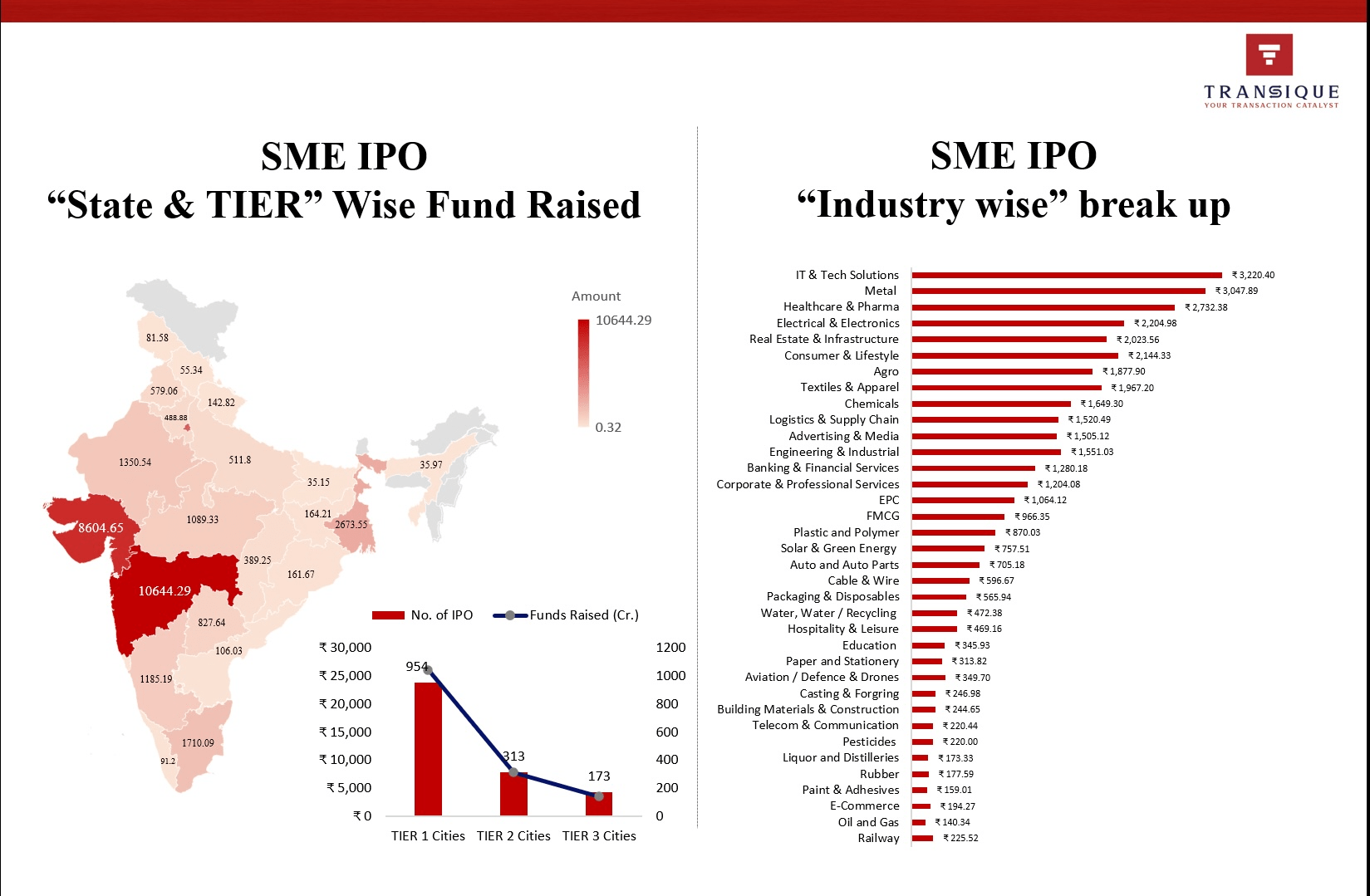
TL;DR — Key Facts About SME IPOs in India (as of March 2026)
- ₹37,500+ crore raised by Indian SMEs through SME IPOs since 2012.
- 1,450+ companies listed across 35+ industries and 130+ cities.
- 82% of total funds (~₹31,000 crore) raised in the last 5 years.
- ₹12,000+ crore raised in 2025 alone by 245 companies.
- SME IPOs are listed on NSE Emerge and BSE SME platforms, regulated by SEBI.
- Winning SMEs focus on growth, profitability, governance, fair valuation, and transparent storytelling.
“The SME IPO success story is no longer restricted to new-age entrepreneurs. Whether you are in manufacturing, services, or a traditional sector, the market has shown it is ready to back credible businesses.”
Assess your SME IPO Readiness Scorecard →
What is an SME IPO? (Definition)
An SME IPO (Small and Medium Enterprise Initial Public Offering) is a public issue of equity shares by a growing SME on a dedicated stock exchange platform — NSE Emerge or BSE SME. The framework was introduced by the Securities and Exchange Board of India (SEBI) in 2012 to give Indian SMEs structured access to long-term equity capital — without the burden of debt, collateral, or fixed repayment obligations.
Why SME IPOs Matter: The Capital Gap Indian SMEs Face
Capital is the lifeline of any business — and especially so for SMEs. For decades, Indian SMEs have relied largely on bank loans to fund growth. While useful, bank debt comes with structural challenges:
- Fixed interest costs, regardless of business cycle
- Collateral requirements such as land, building, or machinery
- Steady cash flow needed for principal and interest repayments
- Promoter equity contribution still required for sanctioning
Equity capital — whether from venture capital, private equity, or IPOs — has historically been accessible only to large, fast-growing tech companies or mature, governance-strong businesses. To bridge this gap for traditional SMEs in manufacturing, services, and distribution, SEBI launched the SME IPO route in 2012.
The Numbers: SME IPO Market Size in India (2012 – March 2026)
| Metric | Value |
|---|---|
| Total capital raised since 2012 | ₹37,500+ crore |
| Companies listed | 1,450+ |
| Industries represented | 35+ |
| Cities represented | 130+ |
| Capital raised in last 5 years | ~₹31,000 crore (≈82% of total) |
| Capital raised in 2025 | ₹12,000+ crore across 245 companies |
| Listing platforms | NSE Emerge, BSE SME |
| Regulator | SEBI (Securities and Exchange Board of India) |
The momentum tells the real story: 82% of all SME IPO capital was raised in just the last five years. What was once a niche experiment is now a mainstream growth engine.
SME IPO Eligibility: Who Qualifies?
While exact thresholds vary slightly between NSE Emerge and BSE SME, the broad eligibility criteria for an SME IPO in India include:
- Post-issue paid-up capital up to ₹25 crore
- Operating track record of at least 3 years
- Positive operating profit of at least ₹1 crore in 2 of the last 3 financial years
- Positive net worth
- No winding-up petitions, no regulatory disqualifications against the company or promoters
- Mandatory 100% underwriting, with 15% on the merchant banker’s own books
- A market maker appointed for a minimum of three years post-listing
The SME IPO Process: 6 Phases at a Glance
- IPO Readiness Assessment — eligibility, valuation, capital structure, governance gap analysis.
- Pre-IPO Restructuring — corporate restructuring, ESOPs, internal financial controls, audit cleanup.
- Appointment of Intermediaries — merchant banker, legal counsel, registrar, market maker, peer reviewer.
- DRHP Drafting & Exchange Filing — due diligence, DRHP filing with NSE Emerge or BSE SME, in-principle approval.
- Marketing & Issue Open — roadshows, anchor allocation, retail and HNI subscription, allotment.
- Listing & Post-Listing Compliance — listing day, market making, ongoing SEBI LODR compliance.
A typical SME IPO journey takes 6 to 9 months end-to-end for an IPO-ready company; companies needing structural prep should plan for 12–18 months.
What Winning SME IPOs Do Differently
SMEs that successfully list — and trade well after listing — share six common disciplines:
- Growth + Profitability: not chasing revenue at the cost of margin.
- Robust Financial Controls: audit-ready, board-approved, system-driven.
- Compliance & Governance: clean tax, labour, environmental, and corporate filings.
- Fair Valuation: pricing for sustainable post-listing performance, not peak greed.
- Transparent Storytelling: clearly articulated business model, moat, and use of proceeds.
- Right Timing: aligning the issue with sector cycles and market sentiment.
Looking Ahead: SME IPOs as a Strategic Capital Tool
Indian SMEs are increasingly using IPOs as a strategic instrument — for sustainable expansion, business transformation, and unlocking hidden value for owners and stakeholders — while raising long-term capital, building lasting market credibility, and attracting long-term investors.
At Transique Corporate Advisors, we have successfully guided SMEs across industries through every phase of the IPO journey — Pre-IPO, IPO, and Post-IPO — helping them raise equity capital, unlock business value, and build credibility while staying in control of their businesses.
Frequently Asked Questions about SME IPOs
What is an SME IPO in India?
An SME IPO is a public issue of equity shares by a Small and Medium Enterprise on a dedicated SME platform — either NSE Emerge or BSE SME. SEBI introduced the framework in 2012 to give growing Indian SMEs access to long-term equity capital outside of bank debt.
How much capital have Indian SMEs raised through SME IPOs?
As of March 2026, more than 1,450 Indian SMEs across 35+ industries and 130+ cities have collectively raised over ₹37,500 crore through SME IPOs. About 82% (~₹31,000 crore) was raised in just the last five years, and ₹12,000+ crore was raised in 2025 alone by 245 companies.
Who is eligible for an SME IPO in India?
Broadly, the company must have a post-issue paid-up capital up to ₹25 crore, a 3-year track record, positive operating profit in 2 of the last 3 years, positive net worth, and no winding-up petitions or regulatory disqualifications. Exact thresholds differ slightly between NSE Emerge and BSE SME.
What is the difference between an SME IPO and a Mainboard IPO?
SME IPOs are listed on NSE Emerge or BSE SME with lower paid-up capital limits (up to ₹25 crore), a minimum application size of ₹2 lakh, mandatory 100% underwriting, and a market maker for three years. Mainboard IPOs follow stricter SEBI ICDR norms and require higher capital and disclosure thresholds.
How long does an SME IPO process take?
A typical SME IPO takes 6 to 9 months end-to-end. Companies that are not yet IPO-ready may need 12–18 months of preparation before filing the DRHP.
What are the benefits of an SME IPO over bank debt?
An SME IPO provides long-term equity capital with no fixed repayment, no collateral, and no interest cost. It also unlocks business value, enhances brand credibility, attracts institutional investors, enables ESOPs, and creates a transparent platform for future fundraising.
Next Steps: Is Your Business SME IPO-Ready?
If you are evaluating equity capital options and want to assess whether an SME IPO is the right fit for your business, our SME IPO specialists can guide you from eligibility assessment to a successful listing.
India’s SME IPO story is no longer a niche experiment — it is a mainstream growth engine. With the right strategy and guidance, your business could be next.

Founder@Transique-IPO Advisory, Equity & Debt Fund Raising, Biz Valuations, M&A Deals,
Transaction Advisory. Member: ICAI Valn Comm.,
Ex Member: Central Govt. (MCA) Valuation Committee, ASSOCHAM M&A Council, ICAI VSB.