

Last updated: 2 May 2026 | Reading time: ~6 min | Author: Chander Sawhney, Transique Corporate Advisors
In one line: India’s SME IPO market in 2026 has entered a quality-led reset phase—fewer but larger listings, stricter SEBI eligibility norms, and rising investor selectivity—creating a stronger long-term opportunity for well-governed, profitable SMEs.
Key takeaways
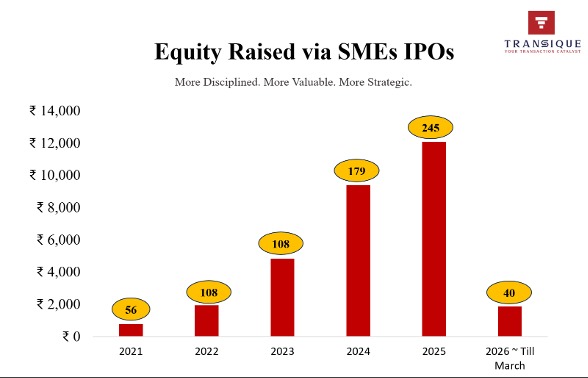
- SME IPO fundraising grew over 15x in five years, from ~₹800 crore in 2021 to ~₹12,068 crore in 2025.
- 268 SME IPOs were listed in 2025 (record), versus 245 in 2024; Q1 2026 saw 40 IPOs raise ₹1,860 crore.
- BSE SME IPO Index peaked at 1,20,269 in January 2025, fell to 74,111 in March 2026, and partially recovered to 92,163 by April 2026.
- Average SME IPO size has risen to ₹45–47 crore, signalling a shift from volume to quality.
- SEBI’s March 2025 reforms tightened eligibility: ₹1 crore+ EBITDA in 2 of 3 prior years, OFS capped at 20%, GCP capped at 15% / ₹10 crore, and FCFE-positive history for NSE Emerge.
How have SME IPOs performed over the last five years?
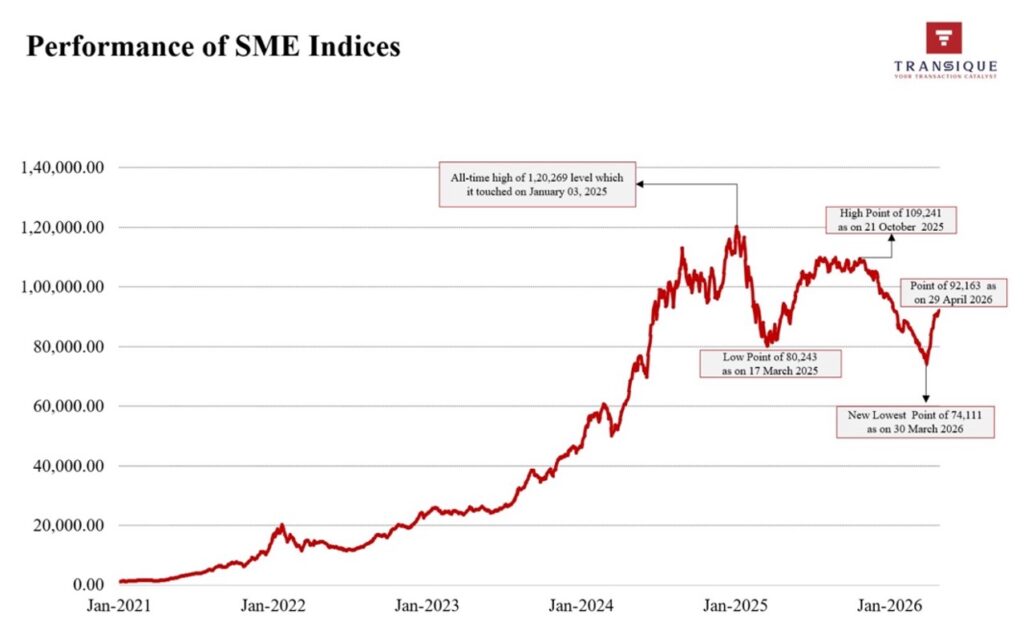
Fundraising through SME IPOs in India has expanded by more than 15 times in five years—from approximately ₹800 crore in 2021 to ~₹12,068 crore in 2025. The journey of the BSE SME IPO Index reflects three distinct phases of investor sentiment and market maturity.
Phase 1 (2021–22): Foundation building
A steady climb as early retail and HNI participation laid the foundation for sustained SME IPO growth.
Phase 2 (2023–24): Breakout rally
Record IPO activity, strong listing-day gains, and rising investor appetite drove a multi-year rally on the BSE SME IPO Index.
Phase 3 (2025–April 2026): Volatility and reset
Tighter SEBI scrutiny and selective funding triggered a sharp correction. After peaking at 1,20,269 in January 2025, the BSE SME IPO Index fell ~33% to 80,243 by March 2025, recovered to 109,241 in October 2025 (~36% rebound), and then declined again to a low of 74,111 in March 2026 before partially recovering to 92,163 in April 2026. The second leg of correction was driven by global macro shocks—50% US tariffs on Indian exports since August 2025 and the Iran–US conflict in March 2026.
What did SEBI change for SME IPOs in 2025–2026?
Beyond fading retail interest after sub-optimal returns over the last 18 months, SEBI’s tighter regulatory framework introduced from March 2025 onwards now requires:
- EBITDA of more than ₹1 crore in at least 2 of the 3 preceding financial years.
- Offer for Sale (OFS) restricted to a maximum of 20% of the issue size.
- Positive Free Cash Flow to Equity (FCFE) in at least 2 of the 3 preceding financial years for NSE Emerge IPOs.
- General Corporate Purpose (GCP) capped at 15% of issue size or ₹10 crore, whichever is lower.
- IPO proceeds cannot be used for repayment of promoter loans.
- A minimum 1-year cooling-off period after a change in promoters before DRHP filing.
- A minimum 1 full financial year after conversion from proprietorship, partnership, or LLP before DRHP filing.
- Strong governance standards with limited Related Party Transactions, executed at arm’s length pricing.
- Heightened disclosures of legal, regulatory, and litigation risks.
- Mandatory Monitoring Agency for fresh issues above ₹50 crore.
- Strengthened merchant banker due diligence and DRHP disclosure requirements.
The minimum retail bid lot size has also been doubled, deliberately raising the entry bar for retail investors. Together, these reforms filter out speculative issuers and reinforce investor confidence in the SME segment.
Why is overall SME IPO fundraising still strong despite fewer listings?
Even in a volatile environment, total SME IPO capital raised has held up because larger, more credible companies are now leading the market.
SME IPO activity at a glance
| Period | IPOs Listed | Funds Raised | Avg. IPO Size |
| 2024 | 245 | ₹9,394 crore | ~₹38 crore |
| 2025 | 268 (record) | ₹12,068 crore | ~₹45 crore |
| Q1 2026 (Jan–Mar) | 40 | ₹1,860 crore | ~₹47 crore |
At first glance, the Q1 2026 slowdown looks concerning. In reality, it marks a healthier transition. Activity in 2025 broke records, and 2026 is now moving past chasing volumes towards quality over quantity. Average issue sizes have steadily risen to ₹45–47 crore—evidence that stronger and more credible companies are accessing the market.
Is 2026 the start of a more mature SME IPO ecosystem?
Yes. What we are seeing in 2026 is not a slowdown—it is a healthy reset. India’s SME IPO market is becoming more selective, resilient, and rewarding for well-prepared companies.
With rising investor expectations and stricter regulation, quality has become the defining factor. SMEs with strong cash flows, robust profitability, sound governance, and clear long-term growth strategies are successfully attracting capital and investor trust. Rising average IPO sizes and steady fundraising despite fewer listings underline this shift.
For SMEs, IPOs are no longer simply about getting listed—they are about signalling credibility, readiness to scale, and the discipline to deliver sustainable performance. While 2025 marked a peak in activity, early 2026 reflects a more measured and mature phase, offering well-prepared businesses a stronger and more sustainable foundation for future growth.
Bottom line: Fewer IPOs, but stronger ones. For investors, SME IPOs are emerging as a more reliable and value-driven asset class.
How are SEBI’s reforms reshaping the SME IPO opportunity?
Based on our analysis at Transique Corporate Advisors, SEBI’s stricter eligibility thresholds introduced in March 2025 are ensuring that only well-governed, financially robust SMEs qualify. The result is a more disciplined, transparent, and mature IPO ecosystem—one where investor confidence is anchored in quality and credibility rather than listing-day pop.
At Transique Corporate Advisors, we hand-hold profitable businesses through their IPO journey with the right strategy, structure, and governance discipline—unlocking hidden value while protecting long-term promoter interest.
Frequently asked questions about SME IPOs in 2026
What are the new SEBI eligibility criteria for SME IPOs in 2025–26?
An SME issuer must report EBITDA of more than ₹1 crore in at least 2 of the last 3 financial years; for NSE Emerge IPOs, FCFE must also be positive in 2 of the last 3 years. OFS is capped at 20% of the issue size, GCP at 15% or ₹10 crore (whichever is lower), and IPO proceeds cannot be used to repay promoter loans.
How much money have SME IPOs raised in 2025 and 2026 so far?
Indian SMEs raised ₹12,068 crore through 268 IPOs in 2025—a record—and a further ₹1,860 crore through 40 IPOs in Q1 2026 (January to March).
Why are there fewer SME IPOs in 2026?
Lower volumes reflect tighter SEBI eligibility, more selective investor demand after sub-optimal returns over the last 18 months, and global macro shocks (US tariffs, geopolitical conflict). Average IPO sizes have actually risen to ~₹47 crore, indicating that larger, higher-quality issuers continue to access the market.
Is the SME IPO market a good opportunity in 2026?
For well-governed SMEs with strong cash flows, scalable business models, and clean compliance, 2026 is a constructive window: investor demand is concentrated on quality, valuations are more rational, and post-listing scrutiny rewards credible execution.
How long does the SME IPO process take in India?
Typically 6–9 months from kick-off to listing—covering financial readiness, restructuring, due diligence, DRHP drafting, regulatory filings, and marketing—provided the company is already audit-ready and corporate-governance compliant.
Next steps for SMEs evaluating an IPO
- Assess your IPO readiness using the Transique SME IPO Readiness Scorecard.
- Book a 30-minute consultation with a Transique IPO expert to map your transaction roadmap.
- Strengthen your corporate governance, MIS, and financial close discipline at least 12–18 months before filing.
Assess your IPO readiness: Transique SME IPO Readiness Scorecard
Book your 30-min consultation with our IPO expert: calendly.com/inder-nnju/30min
About the author
This article is published by the Investment Banking team at Transique Corporate Advisors—a boutique advisory firm specialising in SME IPOs, M&A, transaction advisory, and corporate finance for high-growth Indian businesses. Our team has advised on multiple successful SME IPO listings on BSE SME and NSE Emerge platforms.

Founder@Transique-IPO Advisory, Equity & Debt Fund Raising, Biz Valuations, M&A Deals,
Transaction Advisory. Member: ICAI Valn Comm.,
Ex Member: Central Govt. (MCA) Valuation Committee, ASSOCHAM M&A Council, ICAI VSB.